Publications
(newest to oldest)Graph2Counsel: Clinically Grounded Synthetic Counseling Dialogue Generation from Client Psychological Graphs Aishik Mandal, Hiba Arnaout, Clarissa W Ong, Juliet Bockhorst, Kate Sheehan, Rachael Moldow, Tanmoy Chakraborty, Iryna Gurevych
arXiv 2026 (under review)
In Graph2Counsel, we generate realistic and psychologically consistent synthetic counseling conversations by grounding LLMs in structured graphs of clients’ thoughts, emotions, and behaviors.
[PAPER] - [WEBPAGE] - [DATASET]
Responsible Evaluation of AI for Mental Health Hiba Arnaout, Anmol Goel, H. Andrew Schwartz, Steffen T. Eberhardt, Dana Atzil-Slonim, Gavin Doherty, Brian Schwartz, Wolfgang Lutz, Tim Althoff, Munmun De Choudhury, Hamidreza Jamalabadi, Raj Sanjay Shah, Flor Miriam Plaza-del-Arco, Dirk Hovy, Maria Liakata, Iryna Gurevych
ACL 2026 main Acceptance rate 19%
This paper calls for a rethinking of AI evaluation in mental health by proposing an interdisciplinary framework that integrates clinical validity, social context, and equity, identifying current shortcomings in metrics, professional involvement, and safety, and offering a taxonomy of AI support types to guide more responsible assessment.
[PAPER] - [WEBPAGE]
conference paper
In-depth Research Impact Summarization through Fine-Grained Temporal Citation Analysis Hiba Arnaout, Noy Sternlicht, Tom Hope, Iryna Gurevych
ACL 2026 main Acceptance rate 19%
This work introduces time-aware impact summaries capturing evolving citation intents, with strong expert interest and promising evaluation results.
[PAPER] - [WEBPAGE] - [SLIDES] - [DEMO]
conference paper
Tailored Emotional LLM-Supporter: Enhancing Cultural Sensitivity Chen Cecilia Liu*, Hiba Arnaout*, Nils Kovačić, Dana Atzil-Slonim, Iryna Gurevych
EACL 2026 main Acceptance rate 20%
We introduce CultureCare, the first dataset for culturally sensitive emotional support, spanning four cultures with 1,729 distress messages, 1,523 cultural signals, and 1,041 support strategies annotated for emotion and culture. Using CultureCare, we adapt and evaluate LLMs through multiple strategies with LLM judges, cultural annotators, and clinical psychologists, showing that adapted models outperform peer responses and that simple role-play is insufficient. We further highlight the dataset's potential for training future therapists in cultural competence.
[PAPER] - [WEBPAGE]
conference paper
Using Large Language Models to Create Personalized Networks From Therapy Sessions Clarissa W Ong, Hiba Arnaout, Kate Sheehan, Estella Fox, Eugen Owtscharow, Iryna Gurevych
arXiv 2025
This work offers an end-to-end, LLM-based pipeline that automatically generates clinically meaningful client networks from therapy transcripts, identifying psychological processes, organizing them into interpretable networks, and demonstrating strong expert-rated clinical utility, providing a scalable alternative to data-intensive personalized network estimation for treatment personalization.
[PAPER]
[PAPER]
A Comprehensive Survey of Datasets for Clinical Mental Health AI Systems Aishik Mandal, Prottay Kumar Adhikary, Hiba Arnaout, Iryna Gurevych, Tanmoy Chakraborty
arXiv 2025 (under review)
Mental health disorders are rising, yet clinician availability has not kept pace. AI offers potential support, but progress is hindered by scattered, under-documented, and inaccessible training datasets. We survey clinical mental health datasets by disorder, modality, task, accessibility, and sociocultural context, including synthetic data, and identify gaps such as limited longitudinal coverage, poor cultural diversity, and inconsistent standards. We conclude with challenges and recommendations for building robust, generalizable, and ethical mental health AI systems.
[PAPER]
[PAPER]
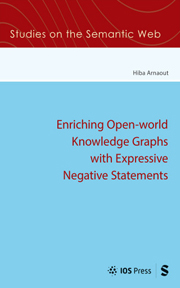
Enriching Open-world Knowledge Graphs with Expressive Negative Statements. Hiba Arnaout
IOS Press 2025
Exploring innovative methods for enhancing knowledge graphs with expressive negative statements, this book will be a valuable resource for those working in knowledge representation, AI, and NLP.
[LINK]
book
Completeness, Recall, and Negation in Open-World Knowledge Bases: A Survey. Simon Razniewski, Hiba Arnaout, Shrestha Ghosh, and Fabian Suchanek
CSUR 2024
In this survey we discuss how knowledge about completeness, recall, and negation in KBs can be expressed, extracted, and inferred.
[PAPER]
journal paper
Wiki-based Communities of Interest: Demographics and Outliers. Hiba Arnaout, Simon Razniewski, and Jeff Z. Pan
ICWSM 2023
Identified from Wikidata, we construct a datasets about 7.5k communities of interest such as The White House Coronavirus Task Force, covering 345k subjects. Every community comes with interesting findings such as demographic data and exceptional members.
[DEMO] - [PAPER] - [DATA]
dataset paper
UnCommonSense in Action! Informative Negations for Commonsense Knowledge Bases. Hiba Arnaout, Tuan-Phong Nguyen, Simon Razniewski, and Gerhard Weikum
WSDM 2023
We present a web portal to showcase the Uncommonsense system. Users can browse interesting negative statements about every day concepts such as elephant, pancake, and acne.
[DEMO] - [PAPER]
demo paper
UnCommonSense: Informative Negative Knowledge about Everyday Concepts. Hiba Arnaout, Simon Razniewski, Gerhard Weikum, and Jeff Z. Pan
CIKM 2022 Acceptance rate 23%
We introduce UnCommonSense, a method for discovering expressive negative statements about everyday concepts. The method significantly outperforms the state-of-the-art on informativeness and recall.
[WEBPAGE] - [PAPER] - [SLIDES] - [POSTER]
conference paper
Utilizing Language Model Probes for Knowledge Graph Repair. Hiba Arnaout, Trung-Kien Tran, Daria Stepanova, Mohamed Hassan Gad-Elrab, Simon Razniewski, and Gerhard Weikum
Wikiworkshop at WWW 2022
We present a method to repair incorrect statements in existing knowledge bases by replacing incorrect triples with likely correct ones, thus avoiding information loss. Our method explores the power of LM probes and shows that context retrieval from the knowledge base itself can significantly boost the probing.
[PAPER]
workshop paper
Negative Statements Considered Useful. Hiba Arnaout, Simon Razniewski, Gerhard Weikum, and Jeff Z. Pan
JWS 2021
We extend previous methods on negation inference by introducing the order-oriented peer-based inference method, which shows an improvement in informativeness.
[WEBPAGE] - [PAPER]
journal paper
Negative Knowledge for Open-world Wikidata. Hiba Arnaout, Simon Razniewski, Gerhard Weikum, and Jeff Z. Pan
WWW Companion 2021
We review Wikidata's attempts to allow negative knowledge and discuss the gains challenges arising from implementing a negation-inference system.
[PAPER]
workshop paper
Neguess: Wikidata-entity Guessing Game with Negative Clues. Aditya B. Biswas, Hiba Arnaout, and Simon Razniewski
ISWC 2021
We publish a guessing game with unique emphasis on challenging negative clues, e.g., a famous English physicist who has never won a Nobel Prize in Physics?
[DEMO] - [PAPER]
demo paper
Wikinegata: A Knowledge Base with Interesting Negative Statements. Hiba Arnaout, Simon Razniewski, Gerhard Weikum, and Jeff Z. Pan
VLDB 2021
A web platform for exploring interesting negative statements about 600k encyclopedic entities.
[DEMO] - [PAPER]
demo paper
Enriching Knowledge Bases with Interesting Negative Statements. Hiba Arnaout, Simon Razniewski, and Gerhard Weikum
The first publication of my PhD, this work introduces the topic of discovering salient negative statements in open-world knowledge bases and proposes to infer candidates from encyclopedic knowledge bases as well as query logs.
AKBC 2020 Audience-choice best paper award (voted by conference attendees) [WEBPAGE] - [PAPER] - [SLIDES]
conference paper
Biological Knowledge Graph Construction, Search, and Navigation. Chandana Tennakoon, Nazar Zaki, Hiba Arnaout, Shady Elbassuoni, Wassim El-Hajj, and Alanoud Al Jaberi
Academic Press 2019
In this book on leveraging biomedical and healthcare data, my contribution is in the writing of chapter 7 on biological knowledge graph construction and search.
[BOOK] - [CHAPTER]
book chapter
Effective Searching of RDF Knowledge Graphs. Hiba Arnaout and Shady Elbassuoni
JWS 2018 Later presented at ISWC 2018
This publication summarizes my Master thesis. It proposes a framework for searching knowledge graphs using keyword-augmented SPARQL queries and ranking results by both relevance and novelty.
[PAPER] - [SLIDES]
journal paper
Top-k Keyword Search over Wikipedia-based RDF Knowledge Graphs. Hrag Yoghourdjian, Shady Elbassuoni, Mohamad Jaber, and Hiba Arnaout
KDIR 2017 Best student paper award nominee
This work proposes a novel retrieval model for general keyword queries over the YAGO knowledge graph.
[PAPER]
conference paper
Result Diversity for RDF Search. Hiba Arnaout and Shady Elbassuoni
KDIR 2016
This paper proposes a method to diversify the results of triple-pattern queries over RDF datasets.
[PAPER]
conference paper